Showing posts with label plant evaluations. Show all posts

Friday, January 13, 2012

More January pictures

Look at those Juniper berries!  Only one of the varieties of junipers that I grow seem to get them with any regularity.  Unfortunately I don't have my garden journal here with me, so I cannot identify the variety.
Then there is the peeling bark on the Acer Griseum, or the Paperbark Maple, growing in front of the house.  We bought this with money given to us by our neighbors when Mom died, and planted it as a memorial to her.  She would have loved it.

The tree has been having a difficult time with the droughts the last two years.  We learned the hard way in 2010 that it needs to be kept moist, or the tips of the branches die.  So, it lost its leader, and seems to be in the process of trying to decide which way to grow next.  When I was in Seattle a few years ago, I saw it planted as a street tree, and figured it must be pretty tough.  But what I forgot to account for was the regular rain and limited number of hot, sunny days that Seattle experiences.  I keep thinking that it will eventually get enough roots down into the soil, and take off.  But for now, it still remains almost the same size as when we bought it. 

A group of evergreens that invite a close view are the Japanese Cedars, or Cryptomeria japonica 'Black Dragon.' This shot shows the buds that are packed on all of the branches.  Sometime in the next few weeks, they will open up, and there will be a yellow cloud of pollen that surrounds the bushes every time they are touched or there is a slight breeze.  If you look closely in the center you can see two of the 'cones,' if that is the right term for them? They are about a half-inch in diameter, and look like a tiny artichoke with a squashed in tip
 
I bought three of these probably ten years ago at the U.S. National Arboretum plant sale, which is sponsored by the Friends of the National Arboretum.  I was attracted by the dense, short needles and their label saying that they were compact, slow growing and 10 feet tall at maturity.

Here is one of the three planted in a cluster near the end of the juniper edge that separates the lawn from the beginning of the slope down into the ravine.  You can see a bit of the juniper at the bottom right, reaching to the base of the cedar.  While there is nothing to provide a sense of scale in the photo, these are quite tall, probably about 8 feet!  So what I expected to be much slower growing is almost to it's "mature" height in just 10 years.  I am not complaining, just surprised.  The problem is that they have grown up into the view of the bay from the labyrinth, but when they were planted, there was no labyrinth!  They stay very dense, as you can tell.  The bits of brown are sections where small branches in the interior die back, I expect because there is just too much jammed together.  I have never had a big branch die back. 

So here is one last picture, looking though the mixed hedge towards the Bay. I swear, I did not dramatically "enhance" the color on this shot.  What you see is what the winter sun created all by itself.  In the center, behind the Crape Myrtle, are the Japanese Cedars in all their glory.


Wednesday, July 6, 2011

Hardy Hibiscus in July

Now that it is July, each of the plants is doing its best to make a show, as the picture above makes clear.  There was one casualty last winter, the large viburnum bush that screens much of the labyrinth from the road and the neighbors nosey eyes, got confused and entered Winter in Spring mode.  Much of it was killed off. 

If you look at the right of the photo where you see our neighbor's bright white front steps, you will see a few of the viburnum's remaining branches.  It is supposed to hide those steps.  You can see on the right, the new suckers that are coming up from the roots.  Each is only about a foot tall, but these are the future trunks of the bush.  Once they get big enough, the old ones will get cut out.

But the topic for today is the hardy hibiscus, of which there are now three.  Each provides some bright color in pink, red or mauve.  If you go back to the top panorama, you can see all three.  In order, from the right and below those white steps is a bright pink one, just to the right of the center tree trunk is a dark red one, and below the left side of our neighbor's arch top trellis is a mauve one.  Each has a different history and style.

The pink one comes from the house my family owned in Pleasant Valley, New York.  My parents bought a large, old farmhouse, and in the first few years I discovered a hibiscus growing along the side of the pond.  When I showed Mom the flowers, she knew what it was, and had me dig it up to plant it up next to the bay window.  This was in the mid-60's, and it was probably originally planted by the previous owners who had landscaped the area near the pond.  I assume it is an early variety of Hibiscus moscheutos, but cannot find any source on the Internet to identify it.

The color is bright and simple, and the flower is not complicated. Each flower lasts about a day.  This particular plant was moved to the current location last fall, and has settled into its new home very quickly.  Since there are not as many buds on it, there will only be two weeks of flowers, but that period may lengthen as the plant gets bigger. 

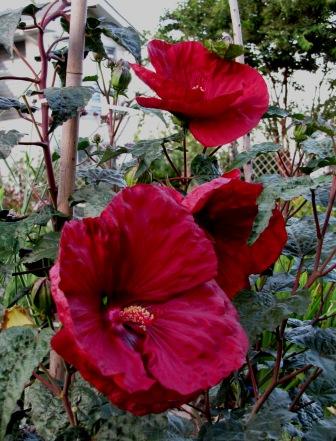
The one in the middle, behind the tree is Hibiscus "Robert Fleming."  Its flowers are HUGE, at least 8 inches across, and open up very flat like a plate.  As you can see in the picture there are many buds to go on this stalk alone, and there are seven stalks.  These flowers stand out even when partially hidden by the foliage of other plants.  I first wrote about it last November, and I am still thrilled with this plant.  My only concern is that at the current rate of growth, which is near a young boxwood hedge, it will soon become much to large.  But I like it where it is.

The last hibiscus, which is a mauve/pink color is to the left.  I must apologize because i had planned to get a close-up of it, but never took that picture.  But then, I also wasn't able to find its name, and since I am trying to be sure to include accurate names whenever possible, I will need to catch up on that one later.  We bought it to grow on the porch last summer, and put it in the ground in the Fall.

I will close with a shot taken from the road to the right of the top picture.  You will see the church bird feeder I painted a couple years ago - this is the first it has been put out in the garden.  We plan a vine to grow up the post, but haven't picked one out yet. The post is there to prevent future vehicles, including snow plows, from driving through the garden and hedges.  If they try it again, at least their vehicle will get as messed up as the garden has been.  Anyway, here is the shot.

Monday, November 15, 2010

Katsura and Viburnum

The Katsura "Heronswood Globe" has now reached its peak color for the fall, a brilliant yellow that glows with the sun coming through the leaves.   This is almost the same color as Ginkgo leaves which are also changing color at the same time, but it is a much more manageable sized tree, only growing up to 15 feet.

I found it at the National Arboretum sale, like so many others, but it is commonly available in many nurseries.  In the five years it has been in place, it has grown a substantially thicker trunk and is now about 8 feet tall.  Some scale of its height can be determined by the Karl Foerster Feather Reed Grass on the right edge of the photo, which is about 5 feet tall.

I irreverently call it my lollipop tree, because of the round ball on top of the stick of a trunk.  It is the only tree that will be planted in the labyrinth, and provides shade for the center.  Soon there will be a chair under it where people can sit in the shade and look at the Bay.

To the right side of the photo, in the back, there is a large, dark green leaved bush.  That is a Viburnum rhytidophylloides Alleghany, which was developed and introduced by the National Arboretum. 

It has deeply indented veins in its leaves, creating shadow lines when the light is right.  The flowers come both in the fall and the spring, and sometimes, as in the photo at the left, berries have already developed before the rest of the cluster of flowers begins blooming.  It is unusual.

This is a very tough shrub, that was bought just after buying the house, and temporarily planted on the north side.  By the time it was moved into its current location a few years ago, it had already grown quite a bit with a large root system.  Digging it out, one root was particularly hard to cut off.  Then a few weeks later when the oil furnace and water heater seemed to have run out of oil, the technician discovered the copper supply line running twelve inches deep alongside the house has been cut!  Oops!

Because this shrub holds its leaves through all but the worst winters, it provides an important screening for the center part of the garden.  It blocks the view into the garden from the houses behind it, and further up the street, offering some sense of privacy.  Here is another view of a cluster of berries and flowers.

Going back to that chair under the Katsura, you may be wondering where is this view of the Bay?  Why is this blog called the Labyrinth by the Bay, when there have been no pictures that showed any kind of view, water or otherwise?   So, here it is, when you turn your back to all of these details.

Wednesday, November 10, 2010

Continued Fall Color

While the native trees are just starting to turn colors in Southern Maryland, one tree is already showing its stuff in the front yard.

This Parrotia persica, or Persian Ironwood, started changing color two weeks ago. Like a parrot, it is flashy and a show-off. The leaves first fade from green into yellow, like those at the top of the photograph at the left.  Then, the yellow transforms through shades of orange to a deep red.  Since the leaves start changing at different times, there is a full range of colors that can be found once the process begins.  This particular tree was bought at the Friends of the National Arboretum Garden Fair several years ago at a 30 inch sapling.  As you can see, it is now over seven feet tall, and has a distinctive shape.  There is no central trunk, and if pruned differently it would have multiple trunks.  Side branches start growing out horizontally, then bend upwards, somewhat like an umbrella that has been blown inside-out.  At first I was worried that there was something wrong since I could not find any good pictures of the trunk-branch shape.  But I like it now.

Once established it has earned its common name of "ironwood" since it is very drought resistant, and shows no vulnerability to insects or disease.  It received little additional water this last hot, dry summer.  It didn't seem to care, while other trees suffered die-back.

Other plants that are continuing to bloom are the Agastaches.  The are two different varieties side by side in this photo.  The one on the left, which is shorter in size and a slightly grayer foliage color is "Acapulco Orange" while the other is "Orange Flare." I thought I was getting two different, though similar, colors between these two varieties, but the only distinction is the height and shape of each plant.  Let this be a warning to never trust a catalog picture to be accurate, especially if the colors in the photo have been increased in intensity.  I won't say which nursery these came from because I have not had a lot of success with the plants from it.  Part of the problem may be that the nursery is located in the Southwest, and the plants have not adjusted to the difference in climate.  I will be curious how these handle the winter, and come back in the spring. 

Thursday, November 4, 2010

Specialist nurseries

While Homestead Gardens and Behnke's are regularly visited, high quality garden centers, they only offer a few of the unusual and riskier plants.  Another favorite local source of hard-to-find plant is the Springtime Garden Fair at the U.S. National Arboretum.  

While each has been provided many of the trees, shrubs, and perennials in the garden, they have limits.  Specialized plant mail order catalogs are the only way to find newer offerings or experimental varieties.  One of my favorites is Plant Delights Nursery in North Carolina.  Their climate and 7b zone is very close to ours in Southern Maryland, though our winters are occasionally colder.

Plant Delights was the source for the Hibiscus 'Robert Fleming,' shown at the left in full blooming mode several weeks ago. It has been a star performer, settling into its site quickly and starting to bloom in the middle of the summer.  It never stopped blooming until the end of September. 


What is equally impressive was to see the trunk that had developed over the summer.  Once the other plants around it had died down and were removed, the large, strong structure of the hibiscus was visible.  Stakes are visible in the photo, both on the right side of the picture and on the back side of the plant.  They were needed to keep the plant upright, since the plant is about 30 inches from one of the labyrinth paths.  Without the stakes, it would have sprawled across the grass, blocking the path.

The full test will be to see how it comes back after our winter weather, which is variable from year to year.  There is rarely enough snow to cover the ground, so there is nothing other than mulch to protect it from all of the fluctuations of temperature. 

I look forward to seeing how it does next year, now that it is fully established.  There will be progress reports in the year ahead. 

Monday, November 1, 2010

Fall Details

This last weekend was perfect for moving plants around, including three peonies and the dwarf smoke bush.  It was also time to plant a hardy hibiscus that had spent the summer blooming like crazy on the front porch.  However, there is no way to get an interesting photograph of chopped off stems sticking out of the ground.  Instead, it is time to pay attention to the small bits and pieces that are scattered around, underneath, and behind the usual display.

It was surprising to find one of the Sedum sieboldii is still blooming, though at the moment the variety is unknown.  Even more surprising were the yellow, black and white beetles feeding on nectar from the flowers, slowly working across the top of the flower heads.  I could not find any matching pictures of beetles in the short web search, so if anyone knows what these are, I would appreciate learning their name.

The two plants need a much more sunny location, now that the viburnum has grown out over them.  Along with the Sedum Autumn Joy, they will get moved into a newly opened flower bed by the road, where they can get lots of hot, bright sun.

Another plant that was a newcomer to the garden this year was the Black-eyed Susan vine (Thunbergia alata).  The plants arrived early in the season, and had to wait a bit before they were planted.  Two pairs were planted  at the base of a tripod of stakes, and one pair below a trellis in front of a clump of tall grass.

The plants needed to build up a clump of leaves and stems on the ground before they would start climbing up the various supports they were put beside.  The tendrils were somewhat weak and never got a tight grip upon their intended stepladders to the sky.  Yet, they did work their way up, and seemed to wrap round each other as they climbed.

There was never a big display of flowers, but a consistent sprinkling from the ground to the top.  Being at eye-level, the simple shape and elegance of each flower was appealing.  The pair that grew into and through the tall grass added a nice surprise of yellow flowers.

It is not clear if they did set any seed, and whether the seeds will come up next spring.  If we recognize the seedlings, we will let them grow, along with many other self-seeders.  But I don't expect to buy either new plants or seeds next year.
 

Monday, October 25, 2010

October Flowers

An ongoing challenge in selecting plants for a garden is finding those that will continue to provide color and interest while the rest of the garden is decaying with colder weather and frosts.  While there have not been any frosts yet, and usually this garden is spared them until the end of November, the options for color this year include two surprises.

This Gaillardia, Oranges and Lemons, was purchased through a mail order company and planted in in spring 2010. It was a slightly random selection, chosen for its combination of color and height, with no specific advice to be found about its qualities or virtues.

It was a very hard start for the two plants.  One almost died after planting, then seemed to resurrect itself. The other did not do much better.  I have had similar troubles with other Gaillardias, so maybe that is a common problem?

Then in the middle of the summer both developed good sized plants, started blooming, and bloomed continuously for the rest of the summer.  While I tried to deadhead them as the flowers dropped their petals, just like the one in the bottom left corner of this picture, the plant didn't seem to care and regularly put out new blossoms.

So, at least for the first year, this seems to be a keeper.  It still has to survive the winter and show its stuff next year, but I am pleased so far.


The other showy plant is actually blooming now because of delay and neglect.  It is a pink Gladiolus that came out of my mother's garden a few years ago.  I have no idea of the name or variety since I pulled these bulbs from the flower bed after it had been rototilled.  

The reason it is blooming is because these were never planted until early September.  While there was a good chance that none would have time to bloom, I decided to take a chance.  So, these came through, but few of the rest have any flower stalks.  I am not a big fan of Gladiolus, but since these were some of Mom's, I have tried to keep them going.  I had heard that these are a favorite of deer, but so far, no chomping has occured.

I have many other plants from Mom, that I will write about as they show their colors.