Thursday, March 10, 2011

Hellebores in March

The extended cold throughout February has delayed the hellebores until this month.  But, as always, the wait is worth it.

With nothing else braving the still harsh weather, the newly emerging leaves and flowers of the hellebores seem to be too tender for what is going on around them.  But, as this one shows, they are up with new leaves and flowers, ready to start a new garden year.  Sure, the crocus are already blooming in the grass, which I reported earlier, and the witch hazels are putting out color and fragrance in abundance.  But it really is the first herbaceous perennial that signifies the beginning of a new year.  With the old name of Lenten Rose, these hellebores have come up slightly before Ash Wednesday this year.  But since this year has Lent starting about as late as it can, if this were any other year, they would have begun blooming a few weeks into that church season.  This one does have that soft, rose color, which I like.  It even has the tapered shape of a rose bud before the petals fully open up.  
I have a number of white varieties, and just bought a new one that has a bright, clean yellow flowers, "Winter's Bliss" which has been showing off on the dining table in the condominium in DC.  But the ones that most thrill me are the dark, deep purple or maroon reds, which seem much harder to find.  This is one of a group of unnamed seedlings I bought from a hellebore specialist a few years ago.  I took the chance on finding some particularly interesting colors and styles, and this one has certainly met that hope. This along with most of my hellebores are in the North flower bed, a small space with the house on two sides, a fence on the third, and our parking pad on the fourth.  I have begun moving some hellebores into sections of the labyrinth beds, as shaded areas grow slowly under various trees and shrubs.  They fit in well in the back of sections that are visible when all else has died down. If I get some other interesting blooms, you will be the first to see the pictures!


.

Tuesday, March 8, 2011

Cutting the Ornamental Grass

A large sweep of tall grass starts behind labyrinth and covers the top of the steep slope down the ravine.  The grass, Miscanthus sinensis 'Gracillimus,' was on site 2000 when we bought the house.  It is on the left side of this photo, behind the low juniper edging.  Screening our neighbor's house from view when it is fully grown, it provides privacy for people who walk the labyrinth.  Its dramatic 30 foot wide drift rolls in waves in the wind, just as the water in the Chesapeake.

Here is a similar photo to the one above, showing the difference with the grass cut down.  Each spring the ornamental grass must get cut before the new green stalks begin growing.  February is the preferred month, with the temperature in the upper 40's or low 50's.  Using the electric hedge shears, this section took six hours to cut the grass, collect the straw and haul it down the hill into the brush heap.


If you look to the left of the tall pencil hollies, beside the edge of the junipers, you can see the brown, rounded stumps of grass.  Our neighbor uses the grass along the edge of her lawn.  I cut off some of that also, which can be seen behind the juniper.

Looking directly at the location from within the labyrinth, you can see the dramatic difference without the soft wall provided by the six to eight foot tall grass.  The Bay is even visible through the leafless trees, though that view will be gone once the leaves open up.  In the next two months, the grass will have grown high enough to provide a sense of enclosure and protection.  It also helps anchor the evergreens so that they don't seem to float so close to the edge.  There is an open view of the Bay, through the gap in the trees made by the ravine, just six feet or so to the left of the picture.  So, as a person is walking along the path away from the road, there is a shift from an intimate, private space to a long view to the horizon.

Thursday, February 24, 2011

Crocus and Witch hazel

The first crocus has pushed up through the grass, just opening their petals at the top of the wheat colored zoysia.  They waited until the temperature got over 60 degrees, but will be followed by many others.  The different colors of the crocus bulbs bloom at slightly different times every year.  The white is always the first, followed by the parchment-yellow ones.  The pale violet usually overlaps those a bit, and the dark violet is usually the last.  I've never known how anyone gets photographs of all the different colors at peak boom at one time?  Perhaps some climates allow for that, but certainly not Southern Maryland.  The early ones will have finished their blooming and started stretching out their leaves to rebuild the bulb before the last will even show color.

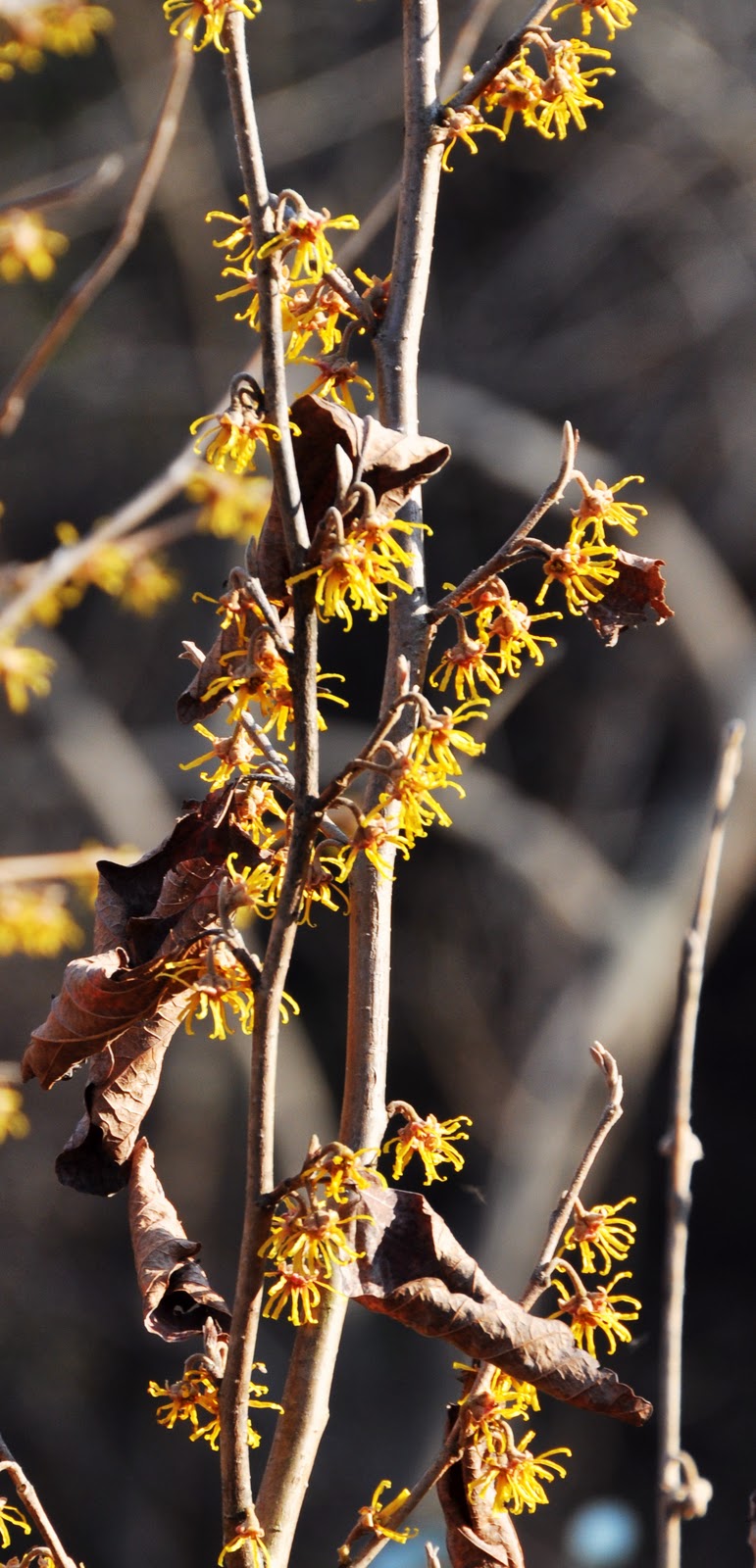
At the same time, the small grove of witch hazel, which has been quietly building up their buds for the first warm day, have burst into full bloom.  There are two remaining Arnold's Promise trees, one died last year.  They   are covered with brilliant yellow clusters of short thready petals, and there is a rich, almost heavy fragrance that is noticible for quite a distance.    I paid dearly for those many years ago, only to find more at half price the following week because the flowers were faded.  I wish I had bought more of them at that time.  But money was tight. 

The flowers are distinctive, with a bundles of long ribbons for petals.  Individually they do not have a lot of impact, but collectively, spread out along the branches, they carry quite a punch in a period with little other color.

So, a year or two later, when I saw witch hazel at a cheaper priced nursery, I decided to buy more.  They were labeled at Arnold's Promise, but the price was suspiciously low.  I decided to take the chance, and what I got were 4 different, probably seed grown native varieties of witch hazel. 

They do not have the punch of color, each being a slightly different mixture of orange with bits of yellow, and the flowers are much smaller.  But they have all grown into much larger, multi-stemmed trees in a  tough location that needs everything possible to hold the soil in place.  So I came out alright in the end.  The one thing I wish I could changes is that a few of them hold onto their leaves from the previous year, right through the blooming season, covering the small flowers they have.

When the witch hazel is blooming, it is time to cut down all of the tall grasses, and haul the straw down the hill to one of the brush piles.  I did that last weekend - pictures of how different it looks will be coming soon. 

Thursday, February 17, 2011

February Flowers

It is that time of year when only the determined bloomers are showing any color in the garden.  For this garden it is the heathers and winter jasmine.  While their colors are soft and their stature is small, against the drabness of the browns and grays, they provide a reassuring hope in the middle of the winter. The heathers, as intended, are visible from the living room windows of the house, and during most of the year are a low and easily ignored grouping at the top of a steep slope.  The current varieties have survived the hot baking sun in the summer and the long cold and wet of the winter.  I have had the most success with starting them as small plants, pampering them for the first year or two, then only watering them during periods of severe drought.  They are pruned down in the spring, to preventing legginess.
One variety that is particularly enjoyable is the Multicolor, with its intense winter foliage color, shown above.  I have lost several and this is my one survivor.  I am not sure what the specific problem has been, and wish I knew what to do.  But I have lost too many to buy any more without some sense of keeping them going. 

I brought out some winter jasmine plants from our house in DC, and though there is not a high spot for them to cascade down, someday I will find the right place. They are holding their own while the right spot will be found someday.

Soon, as the days get warmer, and temperatures rise about 40 degrees, other big, bright flowers will make these small bits of color fade by comparison.  But during the worst of February, they give me hope.

Friday, February 4, 2011

Hoarfrost

With the freezing temperatures and varying forms of precipitation, there is not any new growth or flowers.  but the hoarfrost does create some beautiful effects.  Here are some pictures, without a lot of words, to show that aspect of the garden.

Dwarf holly

Penstemon Husker Red


Close-up on the dwarf holly

Tuesday, January 25, 2011

Mediterranean Respite from the Cold

While I am still preparing the many pictures I took on my recent trip to Cyprus and Egypt for a slide show, I have not had time to take more recent photos of the garden.  Not that there is much to see in the freezing weather.

So here are a couple pictures from the Agios Neofytos Monastery, about 10 kilometers Northwest of Paphos, on the western end of the island of Cyprus.

I will admit I don't know the name of either of the two flowers in these pictures, but that doesn't mean they aren't wonderful.  Coming from a frigid winter, and being able to have temperatures that were only as low at 55 degrees at night, warming up to the upper 70's one afternoon, it was a delight!

There are more pictures of flowers that will be in the slide show, including one of a pink bougainvillea vine growing alongside the old chapel at the Convent of Seven Sisters, on the Sinai peninsula. 

There was also a picture that wasn't-to-be.  Just as I was taking a second picture of that bougainvillea, sprawling up the white painted wall and topping out close to the cross on the roof with a deep blue sky behind, my battery died.  I tried to borrow a battery from the other photographer on the trip with the same camera, but he was not carrying his spare.  When I tried to switch to the Canon, those batteries died! 

So, I stopped, tried to memorize as best I could what I was seeing, taking it as a sign that this was not something to be captured, just enjoyed in the present moment.  I cannot show you the picture in my mind, but it is spectacular!

Sunday, January 2, 2011

Winter Views of the Chesapeake

Now that the trees have dropped their leaves, we enjoy the "seasonal bay view" as it is known by real estate agents and the county tax assessors.  The best views are from behind the house.
This is what is seen from the living room window, with the recently pruned-back holly tree.  It had grown three side leaders, so if you draw a line up from the left edge at the bottom of the tree, it was that wide. 

Then, there is the view from in front of the "blue porch," named for the dark color used by the previous owners.  When the porch gets weather tight windows and a new color, we might have to come up with a new name?

The colors of the heathers add a nice touch to the view, don't they?  The red is a Multicolor, only one of four that have survived.  The variety is much more sensitive to drought than other varieties.

So, enjoy the views. There will be a pause in blogging while the camera goes to visit more exotic terrain.