Tuesday, February 17, 2015

10 Inches of Snow

While New England is getting another layer of snow to deal with, we got our first significant snow for the season.  It is a very dry, fine, fluffy snow, and has been pretty easy to shovel or even sweep off the sidewalk and road.

I was out early to shovel off the snow from around the cars, the parking pad, and on the road. 

There is always something magical about snow in the garden, changing the way I see it.  All the shrubs and still uncut tall grasses stand out in dramatic contrast to the snow.  Low plants, even the early growing daffodil leaves, are covered up making a smooth, sculptural surface.  Shadows become visible and provide a slowly moving layer of detail on the white surface. 

This snow, since it came down so fine and light, doesn't endanger the health of anything.  There is no need to brush it off to prevent it from breaking off limbs and disfiguring the bushes.  It sifts down, into the inside, like confectioners sugar dusted over the leaves. 

That is why I was surprised to see the snow gathered on the plumes of the pampas grass.  The heads of the stems had enough small pieces that the snow was collected.  Neat.


Monday, February 2, 2015

The Feast of the Holly Berries

Bird Parking Lot
I declare a new liturgical holiday on February 2nd.  It is a much more important day than that over-blown and now commercialized groundhog day.   It will be the Feast of the Holly Berries.

Each year in February the ever larger holly tree that grows behind the house feeds hundreds of birds with its berries now softened by the freezing temperatures.  In the photo you can see the edge of the holly tree on the left.  In the distance is the broken, bare branches of the wild cherry tree with two clusters of birds.  On the top are the Cedar Waxwings.  On the lower left side are the Robins.  Further down the hill is a Tulip Tree with another flock.

Other birds are visiting, including Bluejays and the first Bluebird of this season!  Keeping it lively, a squirrel is scampering around trying to get to berries that are close enough to the larger branches that can carry its weight. 

I am glad I can be here to watch them all eat to their heart's delight!  Anytime a visitor asks why we don't cut down the tree to improve our view of the Bay, I tell them how important it is to feeding wild birds for a week or two every year.  I can now claim it a Holy Holly that is central to the Feast of the Holly Berries!

I keep looking for any sign of new growth and new life in the garden.  The last few weeks have been cold, with lots of rain.  Everything is so soaked, I do not dare go out to work.  If I were to walk through the cultivated areas, it would pack down the soil, collapsing all the pockets of air essential to good soil structure.  If I were to try to work in the wild areas, my feet would be constantly sliding since the wet soil cannot bear my weight.  

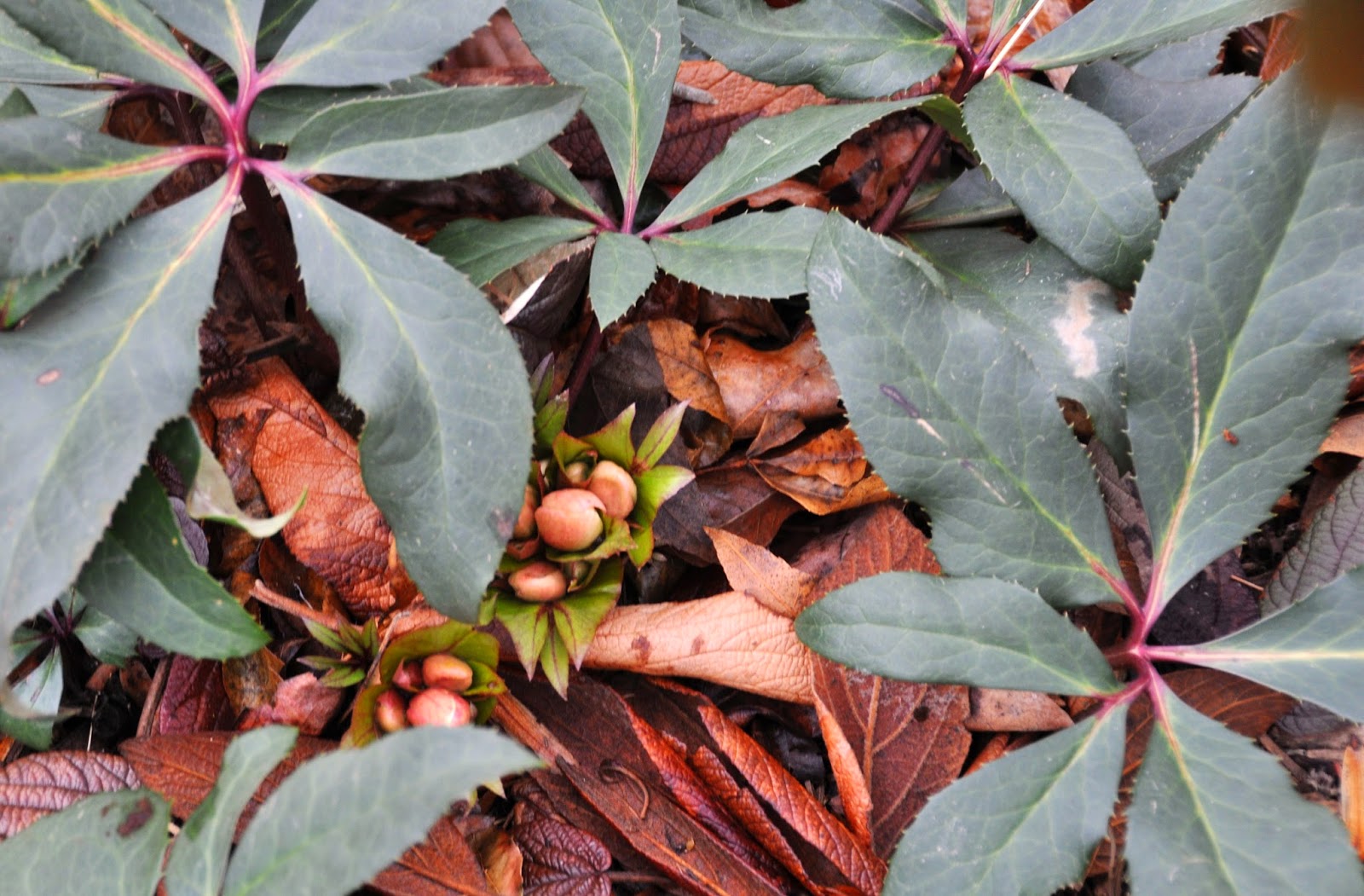
Even the Hellebores have kept their buds tightly shut, just barely protruding above the soil.  They wait for slightly warmer, sunnier days, biding their time.  And so do I.

Monday, December 22, 2014

Winter Red


The Ilex verticillata 'Winter Red' stands out from the background of dark greens, browns, and greys with its brilliant and large red berries.  It has a bumper crop this year, with the wet spring and early summer providing plenty of moisture to this damp loving variety.  But even more importantly, the pernicious deer is no longer hanging out in the labyrinth.  Last year the berries were eaten off as soon as they turned red.  How each year can bring such differences!  As for that deer, I hope someone was able to enjoy some well flavored meat.

Monday, September 15, 2014

Celosia Survivors

So here they are, Sis, the survivors of the Celosia seed that you sent last year.  Two other patches were decimated by who knows which of the varmints, but these came through.  If you look closely, you can still see where tops were chewed off, but there was enough plant for them to pull through.  I did pull a couple of white ones to keep this color for future cycles.

Now that the weather is cooling, the autumn jobs are beginning to become visible.  Unfortunately I spent this last weekend doing a lot of writing for my Clinical Pastoral Education class, so there has been no time to work outside.  Those jobs can wait until later, and so they must for now.

Friday, August 8, 2014

Large Milkweed Bugs

Yep, that is what these critters are called, Large Mildweed Bugs, or if you prefer the Latin name, Oncopeltus fasciatus.  There are probably hundreds on the Purple Milkweed seed pods, and they insert a long tube into the seed pod to eat the milkweed seeds. 

There is one adult visible halfway down this pod, and the rest are nymphs of various ages and sizes.
What is amazing is the crowd of nymphs sitting under the leaf at the bottom of the photo. 

Maybe I should be cleaning them off to protect the seed pods, but I find them fascinating.  The orange is so bright, and they really don't harm anything else, so I will let them be.

Saturday, July 26, 2014

Summer Colors

The center of the labyrinth is showing many colors in the middle of the summer.  The cool blue of the Agapanthus, the intense red of the Hibiscus and the glowing orange of the Crosocmia are competing for the eyes of each viewer.  Even in the bright mid-day sunshine the colors are bold. 

Many gardeners and nurseries like soft, pastel colors.  In some gardens with less intense light and more shade, those colors are subtle and relaxing.  But even with trees and bushes getting taller and offering shade, most of the labyrinth is dazzled by the sun.  It needs colors and flowers that can hold their own, and not wash out.

I adore the true blue of the Agapanthus Stevie's Wonder.  This butterfly was certainly adoring sipping nectar out of its flowers.  There were also different bees reaping the sweet harvest, though some seemed to be struggling to get far enough down into the funnel to reach the good stuff.

While individual flowers may die and fall off the cluster, many buds are forming to replace them.

The Crocosmia Star of the East is putting on its show next to the bench.  It is nice to sit down and reach over to tip the flower up and look into its throat.  This variety is doing a bit of wandering around, even trying to grow into the grass walkway.  I now have enough individual pieces that I will move some into other sections of the beds and see how they do.  I could use more of this intense orange around to provide a spark of color.  I will look for a place that gets more sunshine that this spot under the tree; it gets shade most of the afternoon.

Then there is the Hibiscus Walter Fleming with its deeply creased, heavy textured flowers with the bright yellow stamens.  I have gushed about this one over the years.  It suffered a set back when the white tailed rat chewed off a few dozen flower buds several weeks ago.  But it is stubbornly coming back.
We have been using a foul smelling repellant to keep away the deer and rabbits. It helps.  I did see this morning the deer had eaten off all of the gladiolus flowers, but there was not a major intrusion into other areas.  We have added a number of physical barriers, which shift it out of its habitual paths, however, there is no way to surround everything with the high fence that would be needed.

Like life, a garden needs to be enjoyed a day at a time.  Appreciate each flower and plant, because there is no way to know what tomorrow will bring.  It has been a good summer, with lots of time to be outside caring for everything in cooler than normal weather.   For that I am thankful.


Saturday, July 19, 2014

Lily of the Nile

There they are, the record number of five blooming stalks on my Agapanthus, 'Stevies Wonder.'  So far they have survived the deer, which has been absent since all of the July 4th fireworks were set off by neighbors.  Last year the deer chomped off the heads of buds as they were opening.

Today, we found evidence that the deer came around the end of the fence with our neighbor on the north, because it clewed off a few roses.  It paused to empty its bowels behind the house, and wandered through the labyrinth.  It nibbled on a few of the celosia, just starting to set buds, before leaving.  Such rude and impudent behavior.


We have put in three tall metal fence posts, strung fish line among them, and added three short posts that disappear in the day lilies to poke its legs.  Will it be enough?  I hope so.

Just in case I got these photos, even though all of the buds haven't opened all the way.  I want some documentation that they were here!

There is a lot more blooming.  Near the leg of the bench you can see the orange flowers of the Crocosmia 'Star of the East.  In the bottom right corner are the celosia seedlings, bravely growing in the face of evil predatory deer.

But today I rejoice in my Lily of the Nile!